
The findings of the study using the mobile application called ‘Safetipin’ undertaken by Sakhi Women’s Resource Centre, Thiruvananthapuram with the support of ‘Safetipin’, as a continuation of Safe City Free of Violence against Women and Girls Initiative in Kerala are presented here.The complete report can be downloaded here.
Below are some of the finding of the report.
‘Safetipin’ Initiative in Kerala
‘Safetipin’ initiative in Kerala was launched as a follow up of the Safe City Free of Violence against Women and Girls Initiative with a hope to accelerate the process of transforming our cities into safer places. The study was conducted by Sakhi Women’s Resource Centre,
Thiruvananthapuram with the support of ‘Safetipin’.
The project period in Thiruvananthapuram was four months, from July to October, 2014. Thirty areas in the city were identified for safety auditing and to gather information on safety. In each selected area 25 audits were conducted. By the end of August 800 audits
were completed in Thiruvananthapuram.
ANALYSIS AND FINDING
The survey helped in understanding the level of public infrastructure in Thiruvananthapuram city. It also resulted in finding out the correlation between visibility of women in the cities after dark and the level of public infrastructure. The audit team faced
several issues of moral policing, catcalling and stalking during the audits.
In Thiruvananthapuram, the safety auditors were selected students from Loyola College of Social Sciences, Sreekariyam and other interested students who approached Sakhi, of which 8 were men and 9 were women. A total of 800 audits were completed in 30 different areas in Thiruvananthapuram Corporation between July and August, 2014.
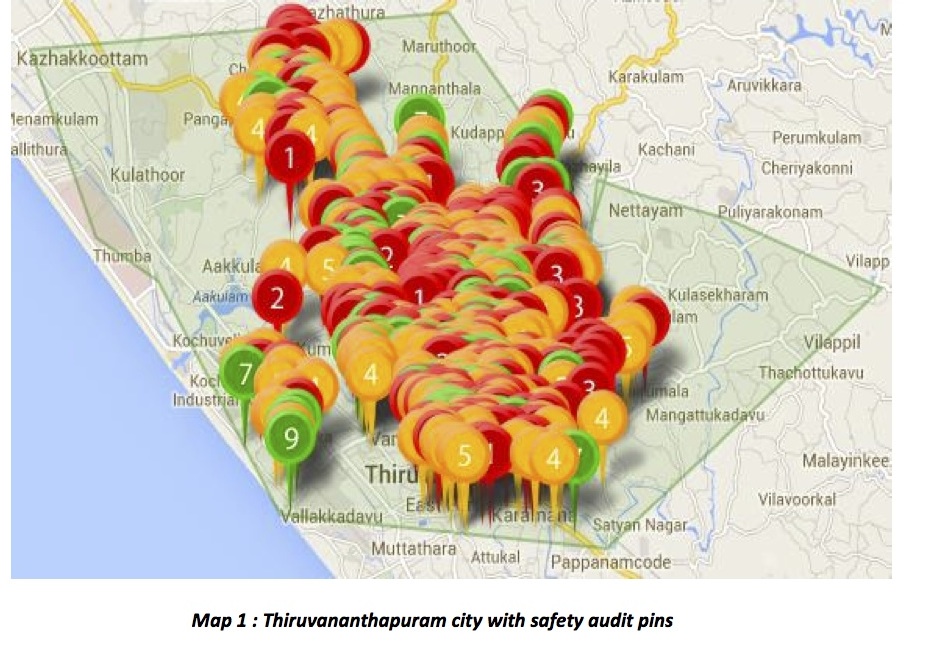
In Map 1, Green pins indicate areas which are safe, amber pins for less safe places and red pins for unsafe placesThe study shows that, despite being the capital city of Kerala, Thiruvananthapuram is far behind in ensuring the feeling of safety. Graph 2 indicates the score of each safety audit parameter on a scale (0-3).
Findings from the audits show that four parameters have lowest rating. These are gender diverse spaces, presence of visible security personnel and walk path. This means that the city does not have the presence of enough women in public places, very few visible security
personnel (private and public) in the city, and no proper walk paths in most of the areas. All other parameters such as availability of public transport, lighting, openness, visibility (which is how well you can be seen by others in a public space) and crowd, the score are higher.